The Email Slush Pile: "I Rarely Reach Out to Authors Directly"
Or: How to Spot a Marketing Pitch Wearing a Goodreads Moderator Badge
September 2, 2026

There are emails that land in my inbox and immediately go into the trash. There are emails that make me pause long enough to wonder whether I should investigate. And then there are emails that make me pour another cup of coffee, open Goodreads, and mutter: “Oh, this is going to be fun.”
Today's specimen came from someone named Kait, who introduced herself as:
Moderator | How to Promote Your Book on Amazon
Goodreads Authors/Readers Book Club
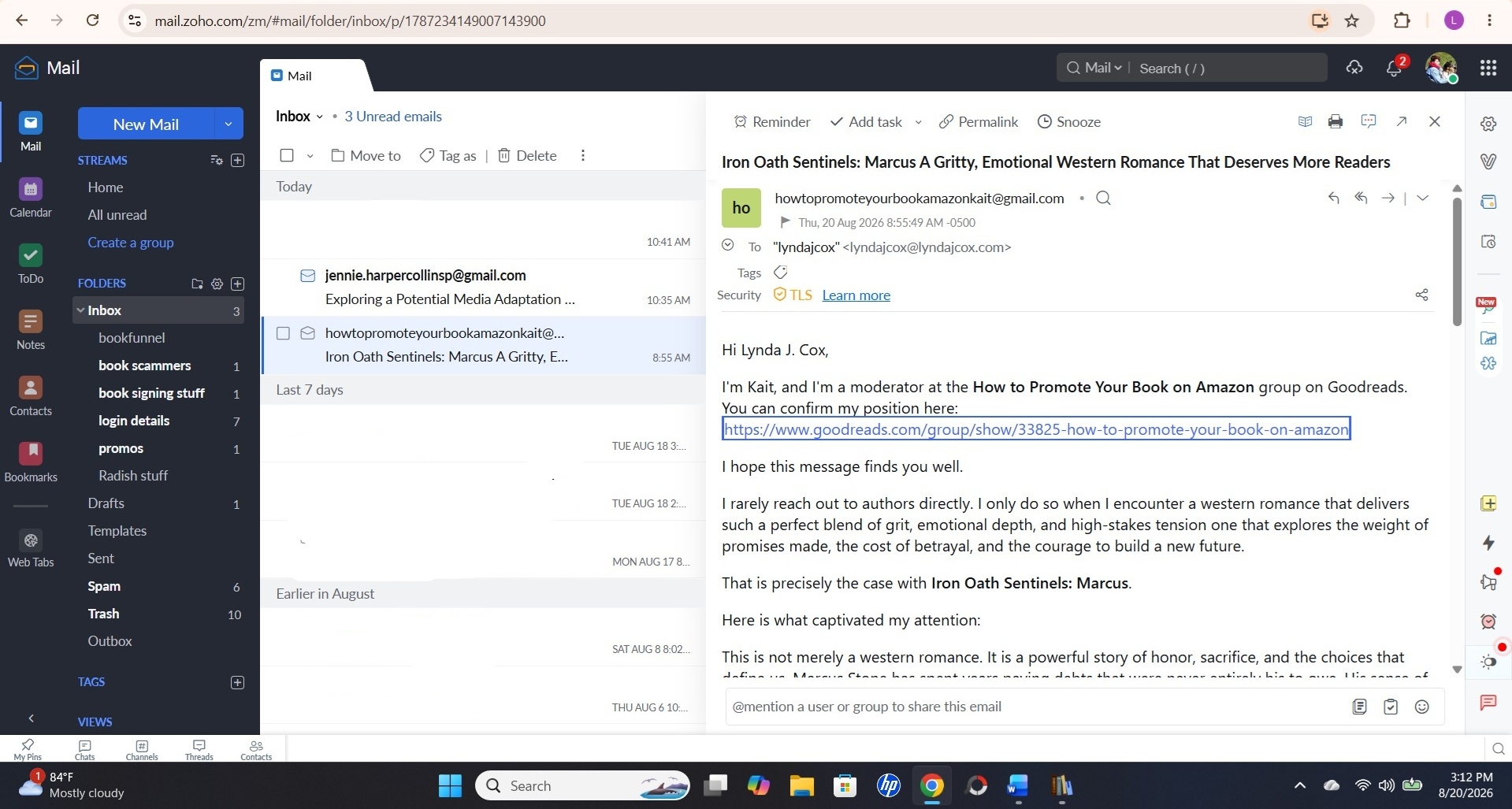
She began with: “I rarely reach out to authors directly.”
Which is always an interesting way to begin an email that has, in fact, reached an author directly. But apparently she makes exceptions. She said she only reaches out when she encounters a western romance that delivers “such a perfect blend of grit, emotional depth, and high-stakes tension...”
The book in question was Iron Oath Sentinels: Marcus.
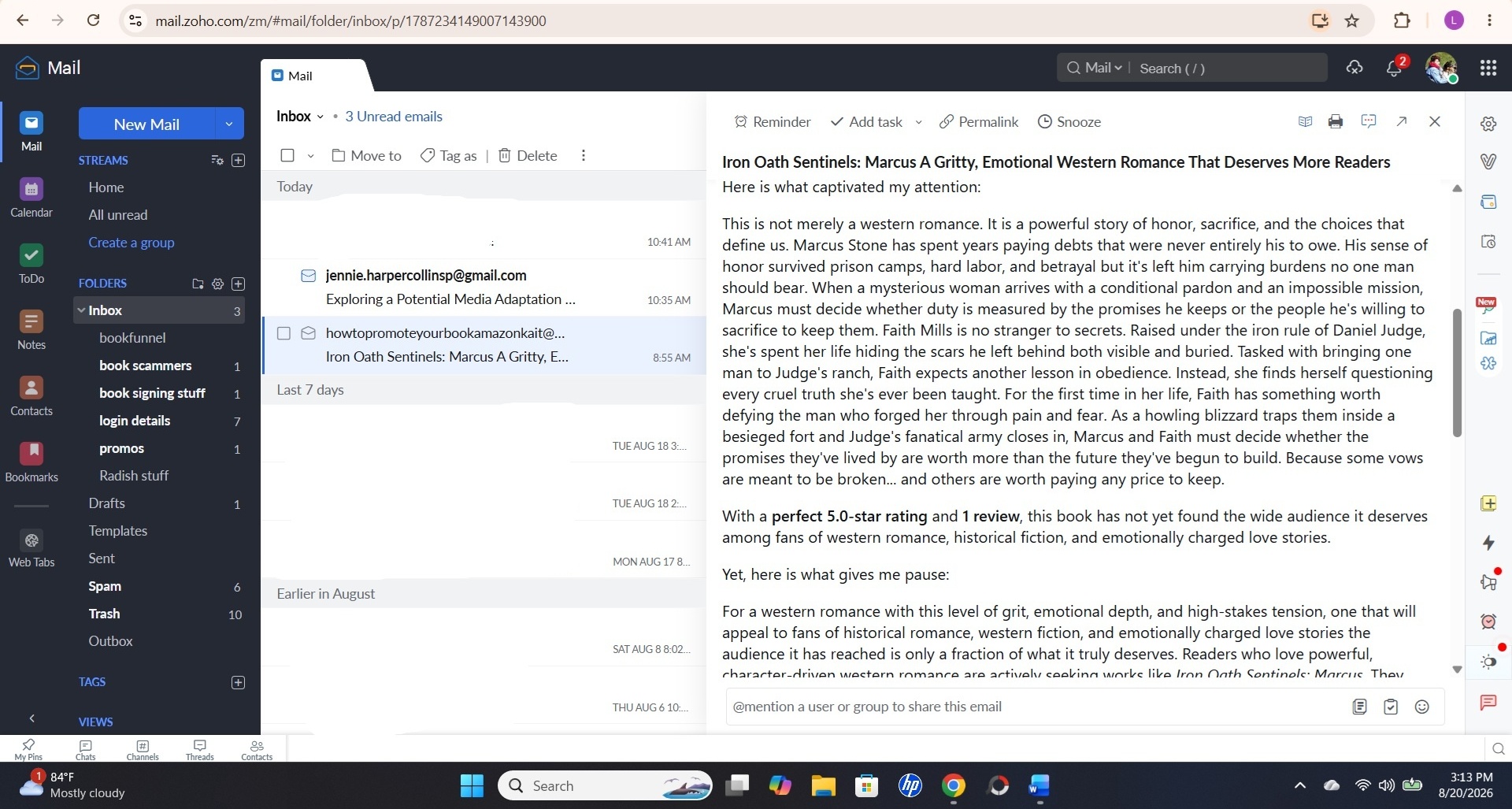
Now, I have no idea whether Kait has actually read the book. I have no idea how she supposedly “encountered” it. And I have no idea whether the lengthy description of the book's characters, themes, betrayals, blizzards, conditional pardons, and fanatical armies was written from having actually read the book or from the book's existing marketing copy.
But she certainly knows how to tell an author what an author wants to hear. The book, she informed me, has:
“a perfect 5.0-star rating”
and
“1 review.”
Well. There we have it.
One person gave the book five stars.
Apparently this is now a marketing credential.
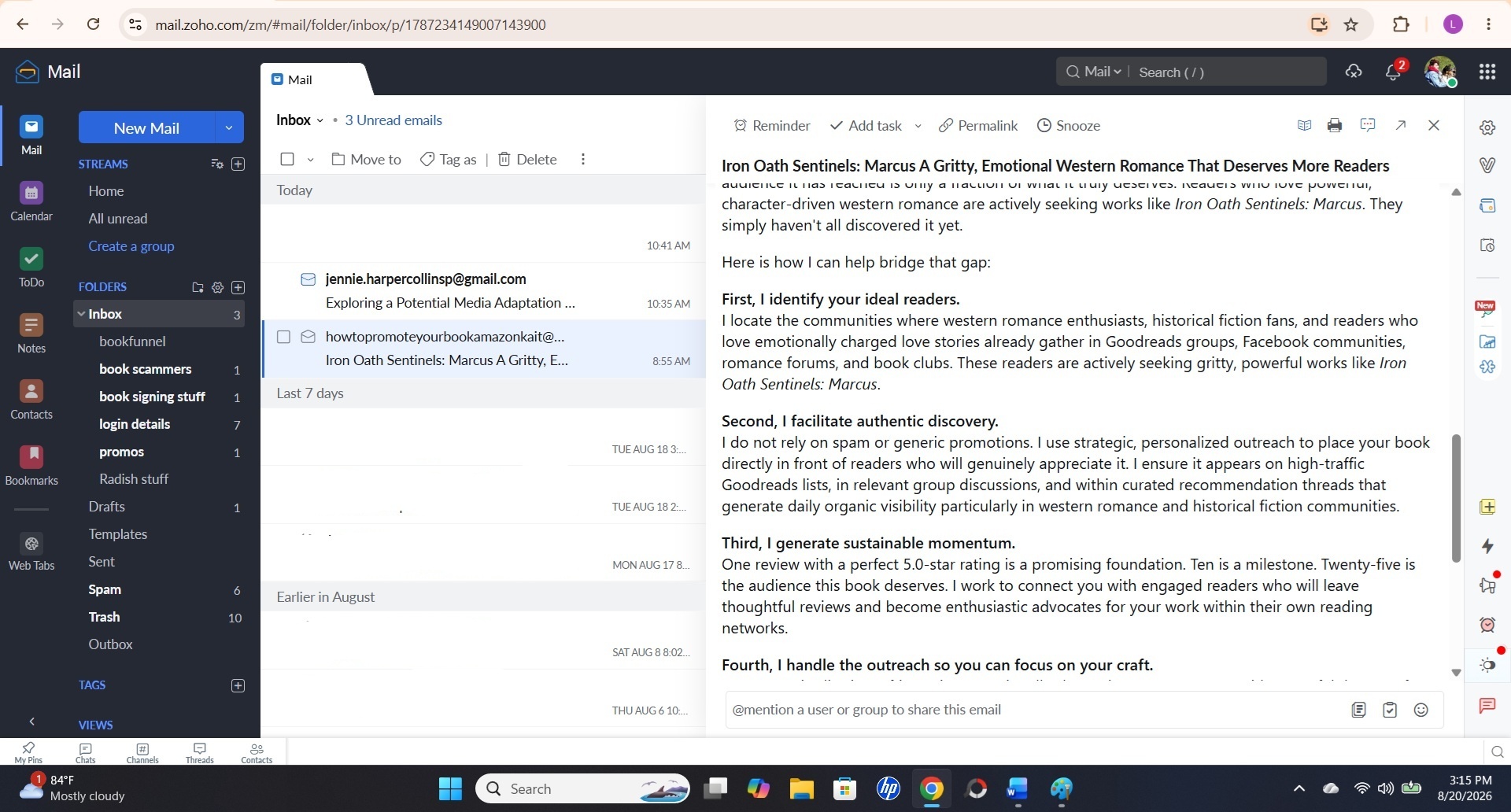
Then came the pitch.
Kait explained that she could:
- Identify my ideal readers.
- Locate communities where those readers gather.
- Facilitate “authentic discovery.”
- Get the book onto “high-traffic Goodreads lists.”
- Generate sustainable momentum.
- Connect the book with engaged readers who will leave reviews.
- Handle all of this so I can concentrate on writing.
It sounds impressive.
It also sounds suspiciously like a collection of marketing verbs assembled into a paragraph. Identify. Locate. Facilitate. Generate. Connect. Handle. Lovely words.
But here's the problem:
Where are the numbers?
If you're telling me that you can help me sell books, I don't particularly care how many beautiful verbs you can put into an email. I want to know:
- How many authors have you worked with?
- How many books?
- What genres?
- What were their sales before your intervention?
- What were their sales afterward?
- Over what period?
- How many books actually gained measurable traction?
- How many reviews resulted?
- What did those campaigns cost?
- What specific Goodreads lists are you talking about?
- How do you get a book onto those lists?
- What exactly does “authentic discovery” mean?
- And perhaps most importantly: what part of the result can you demonstrate was caused by your work rather than ordinary sales fluctuations, advertising, an existing audience, a new release, or other marketing?
Those are boring questions. They're also the questions that matter.
Then I did something I always recommend authors do.
I checked the credential.
Kait provided a Goodreads group link so that I could “confirm” her position. The group exists. That part checks out. But a group existing is not the same thing as establishing that the person contacting you is currently an active moderator, actively working with authors, or currently providing the services described in the email.
In my case, a little digging showed that the Goodreads profile associated with Kait had apparently been inactive since January 2021. That's a rather long gap between “I am a Goodreads moderator who can help promote your book” and “I was last active here five years ago.” And no, I'm not saying that proves the email is fraudulent. It doesn't.
But it absolutely means I'm not going to accept the credential at face value.
Verify first.
Here's another thing that caught my attention.
The email repeatedly emphasized that the book deserved a much larger audience. I agree with the general sentiment. Most authors would like their books to reach more readers. That's not evidence of anything, though.
Telling me:
“Your book deserves a wider audience!”
is not the same as demonstrating:
“Here is what I have done for other authors, here is the measurable result, and here is exactly how I would attempt to reproduce it for you.”
One is flattery. The other is a business proposition. I want the second.
And then there's Goodreads.
This is where my eyebrow went up. The email promises:
“high-traffic Goodreads lists”
and
“curated recommendation threads”
and says the book can be placed in front of readers who are actively seeking this kind of fiction.
Maybe. But authors should understand that being visible somewhere is not the same thing as selling books. A book can accumulate:
- votes,
- likes,
- views,
- recommendations,
- ratings,
- social-media engagement,
- followers,
and still not generate meaningful sales. Visibility is not the same as conversion. Reviews aren't sales. List placement isn't sales. Traffic isn't sales. And a five-star rating from one reader certainly isn't proof of a successful marketing campaign.
The question is always: What happened to the books?
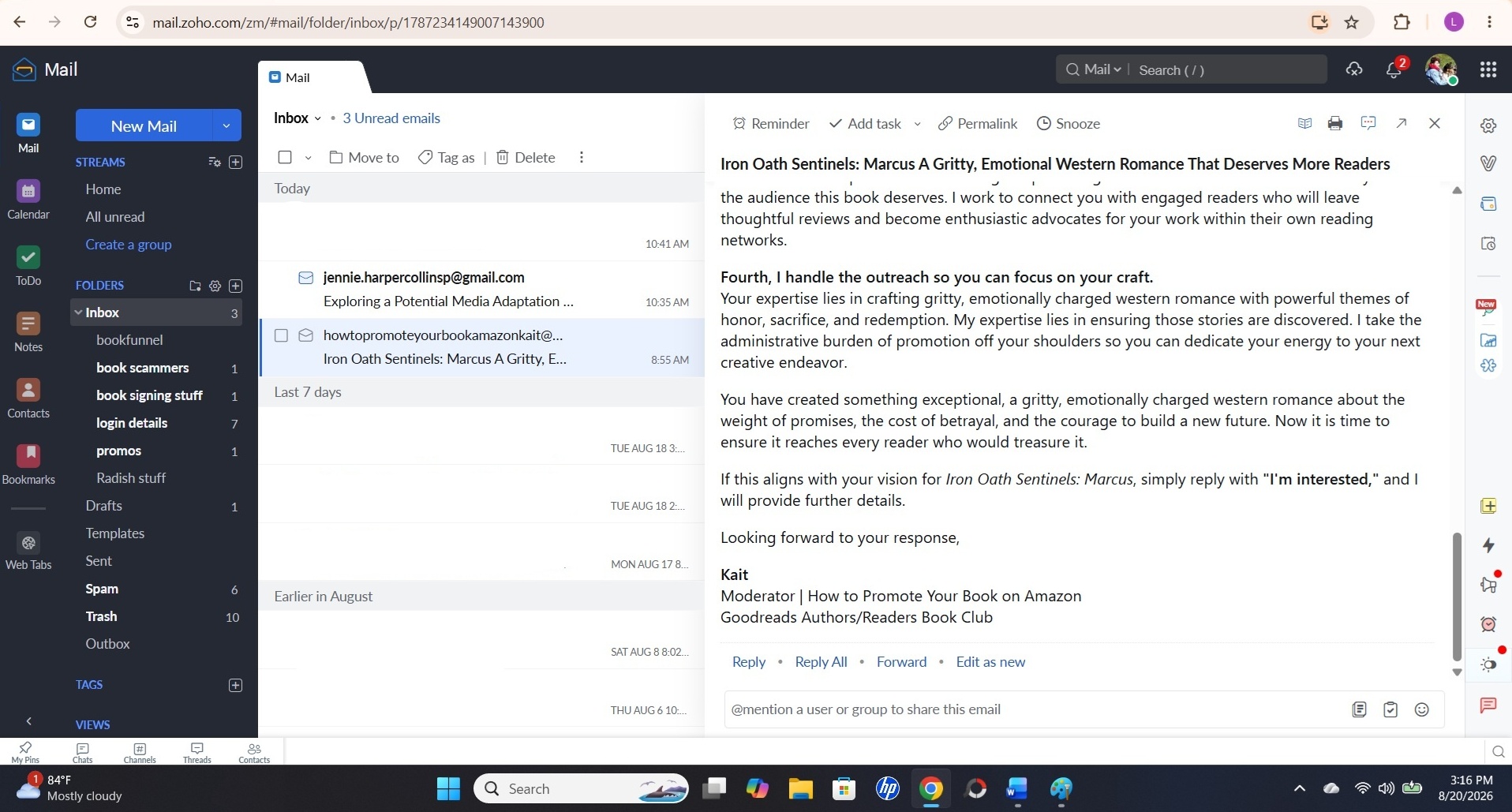
Here's my favorite sentence in the entire email:
“Ten is a milestone. Twenty-five is the audience this book deserves.”
Twenty-five what? Reviews? Readers? Advocates? Because if we're talking about reviews, I have another question:
How are those reviews being obtained?
That matters. A legitimate marketer should be able to explain their process clearly, especially when the service involves Goodreads, Amazon, reviews, ratings, or reader outreach.
“Authentic.”
“Organic.”
“Genuine.”
Those are lovely words. Define them. Don't just sprinkle them through your sales pitch.
The lesson from today's Email Slush Pile
I'm not saying every author-promotion service is a scam. I'm not even saying Kait's service is a scam. I don't have enough information to make that accusation, and neither should you. What I am saying is that this particular email did not give me enough evidence to convince me that spending money with her would produce a measurable return.
And that's all I need to know. I'm not buying a marketing service because someone tells me my book is wonderful. I'm not buying it because someone has a Goodreads group affiliation. I'm not buying it because someone promises “organic visibility.” And I'm certainly not buying it because someone tells me my book deserves more readers.
Show me the receipts. Show me the before-and-after numbers. Show me comparable authors. Show me actual campaigns. Show me what you did. Show me what changed. Explain what part of that change you can reasonably attribute to your work.
Then we'll talk.
Otherwise, thank you very much for the compliment.
The email slush pile has a recycling bin.
And today's specimen is going into it.
A final word for authors
You don't need to become cynical about every unsolicited marketing email. You do need to become curious. When somebody tells you they can improve your sales, don't ask:
“Does this sound good?”
Ask:
“What evidence would I expect to see if this claim were true?”
Then go looking for it. That's a much better filter than whether the email is polished, flattering, or full of impressive-sounding marketing terminology. And if the person can't provide the evidence? You don't owe them your money. You don't even owe them a reply.
Sometimes Delete is a complete business decision.