The Colt That Won the West
Frontier Firearms, Part One
August 6, 2026
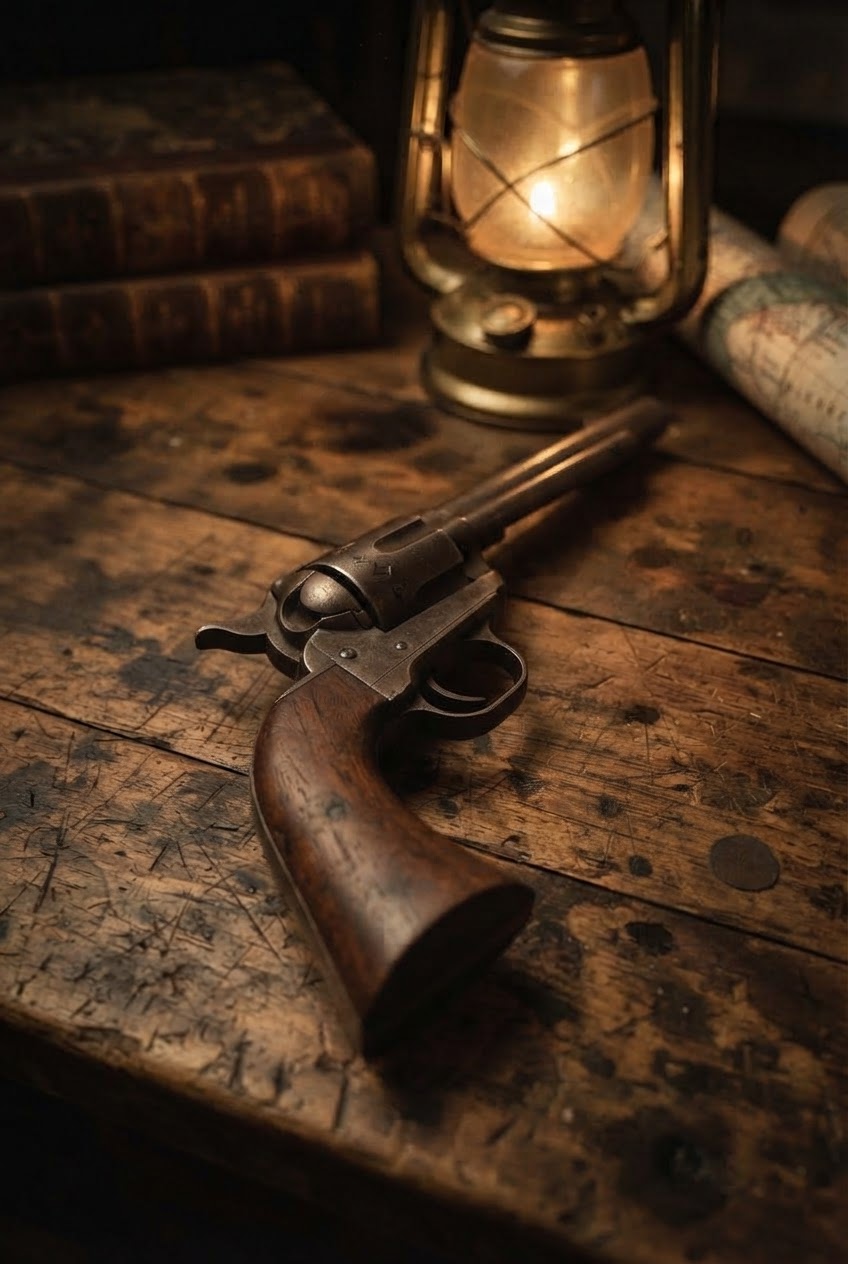
When a reader pictures a Deputy U.S. Marshal riding out of Cheyenne in 1875, the gun on his hip is almost certainly a Colt Single Action Army — the 'Peacemaker,' adopted by the Army in 1873 and sold to civilians not long after.
It was a single-action revolver, which means the hammer had to be thumbed back before every shot. That one detail changes how a scene reads. A man does not 'spray' bullets in 1875. He cocks, he aims, he commits. Six shots, and reloading meant opening a loading gate and punching out spent cases one at a time with an ejector rod. That is a long, exposed handful of seconds when someone is shooting back.
Most careful men carried five rounds, not six, with the hammer resting on an empty chamber. The Colt had no transfer-bar safety; a jolt against the hammer could fire it into a man's own leg. Any character of mine who has spent real time armed knows that trick — and when a character does not know it, that tells you something too.
Chambered most often in .45 Colt, it was heavy — better than two pounds — and it hit like a mule. A frontier lawman wore it butt-forward or butt-back depending on habit, not fashion, and it lived in a simple leather holster on a plain belt. The tooled, silver-mounted rigs came later, from Hollywood.
What I love, as a novelist, is what the weapon costs. A single-action revolver forces deliberation. It makes violence a decision rather than a reflex — and a man who has to decide is a man you can write.